Interior painting punch list
An interior painting punch list is the list of touch-ups and fixes left before a painting job is done. Painting punch lists are about light. Thin spots, roller marks, uneven sheen and wobbly cut lines only show at the right angle. Walk each room with the client's own lights on, and a flashlight held flat to the wall. The JobsiteHQ interior painting punch list below has 14 checks in 4 areas, ready to print.
Walls
- Full coverage with no thin spots, especially behind doors and in corners.
- No roller marks, lap marks or patchy sheen in side light.
- Patches sanded and primed so they don't show through.
- No drips, runs or brush hairs.
Ceilings
- Even coverage with no roller lines, especially near windows.
- Clean, straight line where the ceiling meets the wall.
Trim, doors and windows
- Straight cut lines at walls and ceilings.
- Nail holes filled, caulked joints smooth, no cracked caulk.
- Door edges painted where specified; no paint on hinges or hardware.
- Windows open and close - no sashes painted shut.
Clean-up
- No paint on floors, counters, fixtures, glass or switch plates.
- Cover plates, vents and hardware back on and straight.
- Furniture back, protection removed.
- Leftover paint labeled with the room and color and left for the client.
How do you use this checklist?
Print the 14-check interior painting punch list from JobsiteHQ, or keep the page open on your phone, and walk the job in the order of the sections. Tick each line once you've checked the work. Anything that needs work goes on your own list, with the room and what's wrong. Hand your list to the trade who fixes the items, then walk the fixed items again.
How do you run the final walkthrough?
Walk room by room with the client's lights on, then sweep each wall with a flashlight held flat. The 4 areas of the JobsiteHQ checklist above follow the same route.
- Hold a flashlight flat against the wall and sweep the beam along the paint. Roller marks and missed spots show up straight away.
- Check the wall behind every door. Behind the door is the most common place for a missed spot.
- Look at each wall from the 3 places the client will see the wall most - the couch, the bed and the doorway - not just from the middle of the room.
What gets missed on an interior painting job?
On an interior painting job, the misses are mostly the spots nobody looks at on the way out. The 6 items below are the ones that come back as a call after the final invoice.
- Behind doors and furniture
- Spots behind doors, the fridge and big furniture get found later by the client. Move what you can and look.
- Inside closets
- If closets were in the painting scope, closets are the most skipped space. Check all 3 surfaces inside: the walls, the shelf and the ceiling.
- Tops of trim
- The tops of door casings and crown molding are invisible from the floor. Check the tops of casings and crown from a 2-step stool.
- Touch-up sheen
- A touch-up from a different sheen or batch shows as a patch. Use paint from the same can, and box 2 cans together first if you need a second one.
- Painted hardware
- Hinges, strike plates and outlet covers pick up paint. Check every door and plate.
- Ceiling cut at the crown
- Where the ceiling meets crown or the top of the wall, small waves in the cut line are easy to miss. Look along the ceiling line from a corner, about 10 feet back.
How do you close out the punch list?
Closing out an interior painting punch list means finishing every open item, showing the client the finished work, and handing over what the client needs to look after the work. The 3 steps below come before the final invoice.
- Leave labeled paint for each room, with the color, brand and sheen.
- Do the touch-ups in one visit, with the list in room order.
- Walk the finished list with the client before the final invoice.
Skip the clipboard
Walk the interior painting job with JobsiteHQ open and say what you see, room by room. JobsiteHQ writes the punch list, sorted by area, for you to check over, then turns the list into a client summary, an estimate and an invoice. JobsiteHQ works with no signal.
Try it free for 14 days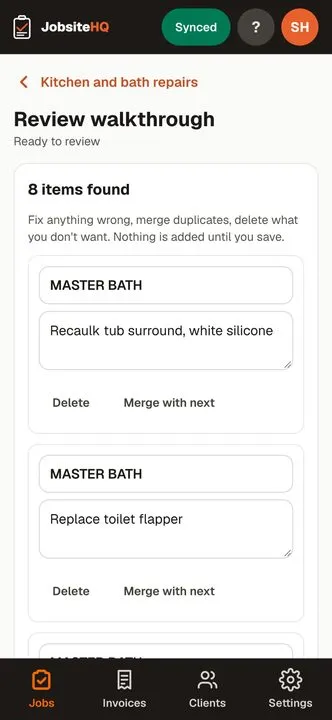
Questions
- When is a painting job done?
- An interior painting job is done when every room has been checked in good light, the touch-ups are finished and the protection is gone. Walking the rooms with the client means you agree on what's left before the final invoice.
- How should touch-ups be tracked?
- Track painting touch-ups room by room, with exactly where each spot is - 'hall, 2 feet left of the thermostat'. A located list turns 'there are a few spots' into a short list you can finish in one visit.
- How long should touch-ups wait after painting?
- Touch-ups should wait until the paint is fully dry, per the can - often 2 to 4 hours for latex. Touching up wet or tacky paint makes the patch show more, not less.
- Should the client be on the walkthrough?
- The client should be on the interior painting walkthrough. Walk each room together with the client's own lights on, and record the walk in JobsiteHQ so the client's list and yours become one punch list.
- What if the client wants a different color after it's done?
- A new color after the job is done is a change, not a punch list item. Price the color change separately, so the original painting job can be closed out and invoiced.